Chapter 1
Story: The Basement Key I Took When They Tried to Take the Vineyard
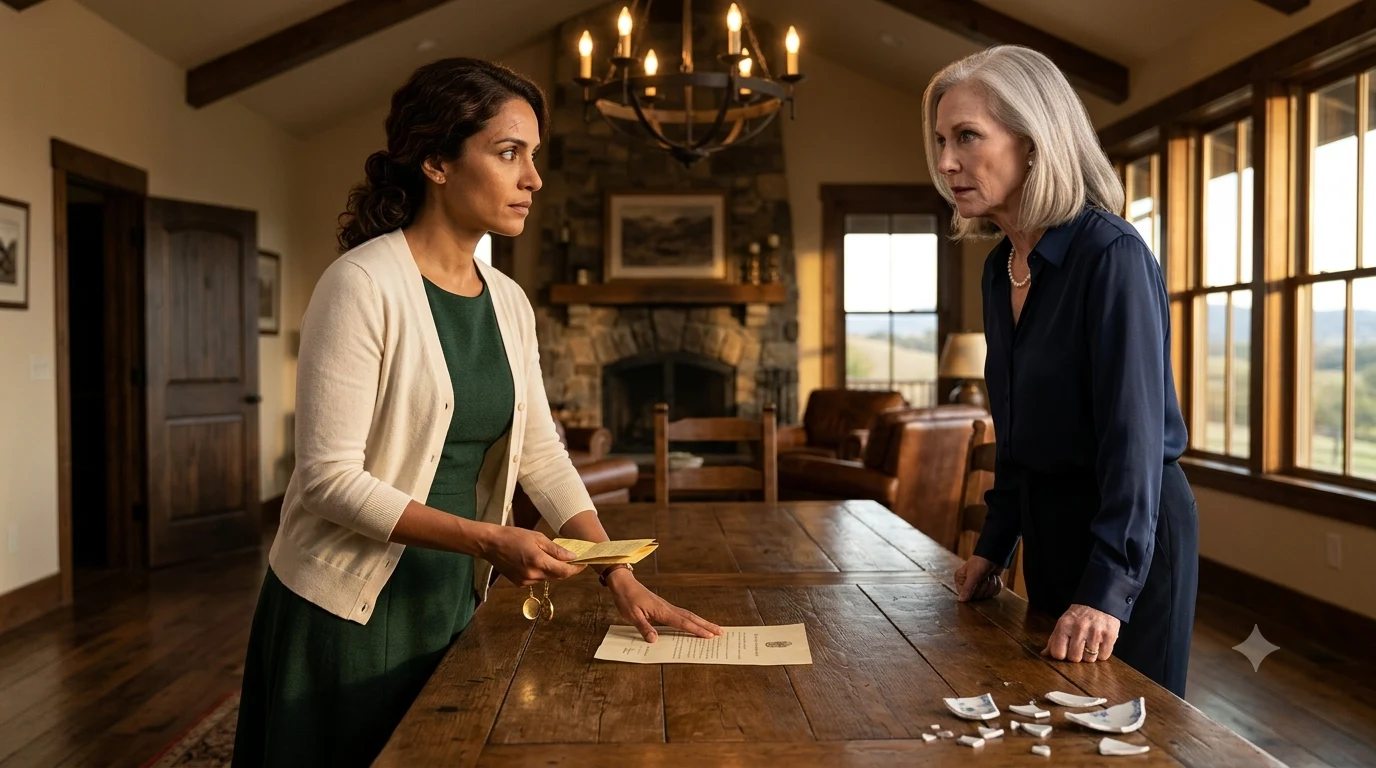
The Basement Key I Took When They Tried to Take the Vineyard
The locket had been warm against Elena's collarbone for thirty-eight years, and in the last four of those years, it had held a secret so heavy that she sometimes forgot how to breathe around it. Right now, seated at the corner of the long oak table in the Hartwell ranch lodge, watching Margaret's thin lips move through the words of a will that would have broken her if she were still the girl they thought she was, Elena could feel the tiny gold clasp pressing into her skin like a second heartbeat.
"—and to our beloved daughter Elena, whom Arthur and I took in when she had no one, we leave the guest cottage for her lifetime, provided she does not contest this document and continues to maintain the property in good standing."
Margaret looked up from the paper, smiled the smile she had perfected over forty years of charity dinners and condolence letters, and added, as if it were an afterthought: "We thought it was generous. Given everything we've done for you."
Around the table, fifteen faces turned toward Elena. Some wore sympathy like a borrowed coat that didn't fit. Others — Lucas and Daniel, the biological sons, seated on either side of their mother — wore barely concealed satisfaction. The lawyer, Samuel Crane, adjusted his glasses and did not meet her eyes. Her husband, Marcus, reached over and squeezed her hand, a gesture that meant nothing, because he had already been promised his share of the management fee and she had heard him discussing it with Daniel in the barn that morning when they thought she was still in the house.
Elena did not cry. She did not argue. She did not stand up and scream, which is what Lucas was clearly waiting for, his fingers already drumming on the table like he couldn't wait to be offended by her ingratitude.
Instead, she breathed.
In through the nose, out through the mouth. The same breath she had practiced in the bathroom mirror every morning for four years, ever since the day her adoptive mother — Arthur's first wife, the real one, the one Margaret had replaced a decade later — had called her into the hospital room and pressed the locket into her hand and said, "You are not who they told you you were, and this is not what they told you it was."
Margaret was still smiling. "Elena, dear. Did you hear me? The guest cottage. It's yours. For as long as you live, as long as you—"
"Did you really think I never read the deed, Mother?"
The words came out quiet. Calm. Almost gentle. They landed on the table like a stone dropped into still water, and the ripple went through the room in a way that shouting never could have.
Margaret's smile didn't disappear so much as it froze, mid-motion, like a photograph developing in reverse. Her hand, which had been gesturing toward the guest cottage as if it were a prize, stopped in mid-air.
Lucas stopped drumming his fingers. Daniel stopped smirking. The lawyer's glasses caught the golden hour light as he lifted his head, and for the first time since the reading began, he actually looked at Elena.
"I'm sorry?" Margaret said, and the single word — Mother — hung in the air between them like a live wire.
Elena's hand moved to her collarbone. She had waited four years for this moment, had rehearsed it in her head a thousand times, and still she could feel the tremor in her fingers as she closed them around the thin gold chain. The locket was warm from her skin. It had belonged to her biological mother, and before that to her grandmother, and the weight of it had been the only thing that made her feel connected to anyone at all in all the years she had lived in this house as a grateful orphan who owed everything and owned nothing.
"I said," Elena repeated, her voice still soft, still steady, "did you really think I never read the deed? The original one. The one my father signed the week I was born."
Margaret made a sound — a small, strangled laugh that came out wrong. "Elena. That's absurd. The deed to this ranch was signed by Arthur Hartwell in 1980. I have the papers. Samuel has the papers."
"That's not what I'm talking about," Elena said. "I'm talking about the deed that was signed by Tomas Márquez in 1987. The one that transferred this ranch into his name. The one that was never rescinded, never sold, never transferred — because the man who was supposed to inherit it died in a stable fire before he could sign anything else."
Silence. A heavy, suffocating silence that pressed down on the room from the exposed beams above.
Margaret's face had gone pale under her carefully applied makeup. Her hand dropped to the table, gripping the edge with fingers that had turned white. For a moment — just a moment — something flickered in those cold blue eyes that Elena had never seen there before. It was not guilt. It was recognition. It was the look of a woman who had spent forty years believing she had buried a secret so deep that no one would ever dig it up.
"Elena." Margaret's voice had lost its practiced warmth. It was sharp now, cutting. "That is a private family matter. How dare you—"
"How dare I?" Elena finally stood. Not fast, not aggressive — just stood, slowly, pushing her chair back an inch, letting the full height of her five-foot-six frame fill the space that fifteen seated people had been using to tower over her. "How dare I, Mother? How dare I walk into this house where I was raised by a man who killed my father and married my mother's death? How dare I sit through a reading where you offer me the cottage of the people who did the killing, as if it's charity?"
June made a sound. It was small — a sharp intake of breath, the clatter of a teacup against its saucer. Elena's eyes darted to her sister-in-law, the woman seated mid-table on the left, the one with the gentle brown eyes and the lavender cardigan that always seemed a size too soft for this room. June's face was white as bone. Her teacup trembled in her hands, sloshing liquid over the rim, staining the white tablecloth in a spreading circle the color of weak tea.
"I told you," June whispered, so low that only the people nearest her could hear. "I told you this would come back. I told you."
Margaret's head snapped toward her. "June. Be quiet."
But June was already standing, her chair scraping back against the floorboards with a sound like tearing fabric. Her hands were shaking so hard that the teacup slipped and clattered onto the table, rolling, spilling, nobody moving to stop it. She was not looking at Margaret. She was looking at Elena, and there was a terror in her eyes the size of the whole ranch.
"The basement," June said. Her voice cracked. "Tell them to check the basement. There are boxes. I couldn't— I couldn't, Mother. I couldn't."
Margaret's face collapsed. Not into anger, not into denial, but into something Elena had never seen on her adoptive mother's face in thirty-eight years: pure, unfiltered fear.
And in that moment, standing at the corner of the oak table, her fingers still wrapped around the warm gold of the locket that had been her mother's, her grandmother's, hers, Elena understood that she had not misread the situation at all. She had under-read it. What she had known for four years — what she had carried in the locket, in her own hands, in the careful accounting ledgers she had kept for the family for fifteen years — was the truth about the fire, and the deed, and her father's murder. But it was not all of it.
June's terror said there was more.
"What's in the basement?" Elena asked, her voice barely a whisper.
Margaret's mouth opened, but no sound came out. June was crying now, silent tears streaming down her round cheeks, her hand pressed against her mouth, the brass key on a retractable reel at her belt glinting in the golden light.
Elena turned to Samuel Crane, the lawyer, who had gone completely still at the far end of the table, his face a mask of professional neutrality that was cracking at the edges. "Samuel. Do you know what's in the basement?"
He did not answer. He didn't have to. The look on his face — the way his eyes darted to Margaret and then away, the way his hand had stopped holding his pen mid-air — told her everything she needed to know. The will he was reading was a lie. The deed she held was a lie, inverted. And the basement was the place where the truth had been stored, boxed up like bales of old hay, waiting for someone to open the door.
Marcus was standing now, too. He had moved to her side, one hand reaching for her arm, his face a careful mask of concern. "Elena, let's just slow down here. Let's just—"
She pulled her arm away. Not violently — she had never been a violent person, had spent her entire adult life practicing the patience of a woman who had learned to wait for the right moment. But she pulled away, and she fixed him with a look that had four years of history behind it.
"You knew what they were doing today," she said. "You sat next to me and you smiled."
Marcus's face flickered — guilt, fear, something else she couldn't name — before he smoothed it over. "I didn't know—"
"You knew enough to be smiling. Enough to be checking your watch." Elena's voice was cold, flat, the voice she used when she was going over the books and found an entry that didn't add up. "You already counted your share of the management fee."
Samuel Crane cleared his throat. His voice, when it came, was shaky, the voice of a man who had spent thirty years in the service of a family he was only now beginning to see clearly. "Ms. Hartwell. I need to— I need to examine that deed you're holding."
"You need to do a lot more than examine it," Elena said. "You need to call the county sheriff. And then you need to open the basement door."
She laid the deed flat on the table, her palm pressing it into the dark oak, the typed name — Márquez — visible in the flaking ink of 1987, thirty-eight years old, older than her own memory, signed by a dead man who never got to see his daughter grow up. The room bent around that piece of paper like light bending around a black hole.
Elena turned her head toward the far end of the hall, past June's trembling shoulders, past the basement door that stood slightly ajar. A thin line of lamplight fell through the crack, falling across the floorboards in a single golden stripe, as if inviting her in.
And behind her, she heard the lawyer pick up the telephone.
The first deputy arrived in seven minutes. Elena counted them — not because she was watching the clock, but because she had spent her entire life counting things, keeping track of what everyone else was too busy to notice. Seven minutes was long enough for the room to rearrange itself around the new shape of what had happened. Samuel Crane had gone to stand at the far end of the hall, one hand still on the phone, his face the careful blank of a man who had just realized he had been a cog in a machine he should have examined years ago.
Margaret pulled herself together more quickly than Elena expected. The matriarch smoothed her silver hair, squared her shoulders, and walked over to stand beside Elena at the corner of the table, as if they were two women admiring a shared view. Her voice, when she spoke, was low and composed — the voice of a woman who had survived forty years of county politics and family warfare by never once letting anyone see her bleed.
"Whatever you think you have," Margaret said, "you have nothing. You understand me? Nothing. The deed in your locket is a forgery. The letter in your room is a fabrication. I don't know who gave them to you, but I promise you, when this is over, you will wish you had kept them hidden."
"June gave me nothing," Elena said. "June never had to give me anything. I read the ledgers. Fifteen years of the books for this family, Mother. Fifteen years of watching every penny go through my hands. You know what I found? Nothing. Not a single copper cent of compensation ever went to a man named Arthur Hartwell for the purchase of this land. Because he never purchased it. My father purchased it. With a loan from the Sonoma Valley Bank that his foreman — your husband — was supposed to be holding in trust the night my parents died."
Margaret's face twitched. Just once, a muscle jumping at the corner of her jaw, a tic Elena had seen only a handful of times in her life, always in moments when the matriarch was losing control and trying desperately to hide it.
"The fire was an accident."
"It was arson," Elena said. "There was an insurance investigation. The report was sealed, but I found it. Fifteen years of going through your files, Mother. You never once thought to wonder why I always volunteered to do the archival filing. Why I never complained when you gave me the job of cataloguing the old documents. You thought it was gratitude." She let the word hang in the air. "It was diligence."
The second deputy arrived at minute twelve. He was younger than the first, with the suspicious eyes of a man who had grown up in the county and knew exactly which families wrote the checks that kept the lights on. He looked at Margaret, and his hand moved toward his radio, and Elena saw the decision happening behind his eyes before he made it.
"Sheriff's on his way," he said. "He wants to know what we're looking at."
Samuel Crane answered before anyone else could. "We're looking at a possible question of property ownership," he said carefully, his lawyer's instinct kicking in. "And a possible question of criminal conduct. We need the basement opened."
June let out a sound — a small, strangled sob — and made a break for the door. Elena saw her move, saw the flash of the brass key on the retractable reel at her hip, and for a split second, she thought June was going to run. But instead, June stopped at the threshold of the hall, turned back, and looked at Margaret with eyes that were red and swollen and suddenly, fiercely clear.
"No more," June said. "I've kept your secrets for twenty years. My children are grown. My husband doesn't care what I do anymore. And I'm done." She unhooked the key from the reel, the brass catching the lamplight, and held it out to the first deputy. "Basement. Down the hall, third door on the right. It's locked. I've had the only key for four years because Margaret thought I was too afraid to use it."
Margaret lunged for her. Elena moved before she could think — a step sideways, a hand catching Margaret's wrist in a grip she had learned from fifteen years of mucking stalls and hauling hay bales, a grip that was far stronger than the family had ever believed possible from the quiet accountant who kept their books.
"Don't," Elena said. "You've been in control of this room for forty years. That's over now."
Margaret stared at her. The cold blue eyes, which had frozen Elena in place countless times over the decades, looked different now. They looked scared. They looked old.
Elena reached into the collar of her dress and pulled out the locket — not the closed one she had worn for years, but the open one, the shell split in half, the interior lined with a photograph that was worn and faded and still unmistakably her mother's face, and the folded deed that had been the key to everything. She set it flat on the table in front of her, next to the will that Margaret had been reading, and she watched the room absorb the difference.
The will was typed, embossed, dated three weeks before Arthur's death, on paper so crisp it had obviously never left the lawyer's file.
The deed was old. It was handwritten in the flowing script of a man who had learned to write in another language, in another country, who had come to this valley with nothing and built a ranch that his daughter had spent fifteen years keeping out of the family's own bankruptcy. It was signed. It was notarized. It was dated February 14, 1987 — six months before the fire that killed her parents.
"Sheriff's outside," the older deputy said. His radio crackled. He looked at the deed, and he looked at Margaret's face, and Elena saw the moment he decided which side of the law he was on.
June had not moved. She stood at the threshold, the brass key still extended in her hand, tears streaming down her face, her lavender cardigan glowing in the dying light.
"The basement," she repeated. "Please. Someone check the basement."
Advertisement